Is Rome Safe? An Honest Answer From Someone Who Lives Here
Short answer: yes.
Longer answer: yes, with the nuances you’d expect from any large metropolis. Rome has millions of inhabitants, and it would be stupid to pretend there’s no crime in the capital of Italy.
But the situation is very much under control — particularly in the centre, where there’s a heavy and constant presence of police and army.
You’ll probably arrive with more fear than you need.
What people worry about, and what actually happens
Here’s the gap worth understanding before you come.
What visitors fear: violence. Being robbed at knifepoint. Something happening to them.
What actually happens: almost none of that. Rome doesn’t really have street robbery in the way people imagine it. What Rome has is pickpockets — and they’re extremely good at what they do.
That’s the whole shift in mindset. You’re not protecting yourself from danger. You’re protecting your pockets from professionals.
We’ve written a full guide to the scams and how they work, because that’s where your attention actually belongs.
Daytime: you’ll be fine
During the day you’ll have your peace of mind, especially in the central areas — and again, that’s where the police presence is heaviest.
The only real thing to keep in mind is pickpockets, and they operate exactly where you’d expect: wherever there are crowds and tourists. Not in quiet streets. In the press of bodies at a monument, on a packed bus, in a queue.
Stay aware in the crowds and relaxed everywhere else. That’s genuinely the whole strategy.
Night: the centre never really closes
Here’s the part that surprises people.
In the centre, there is no unsafe hour. The centre is always safe.
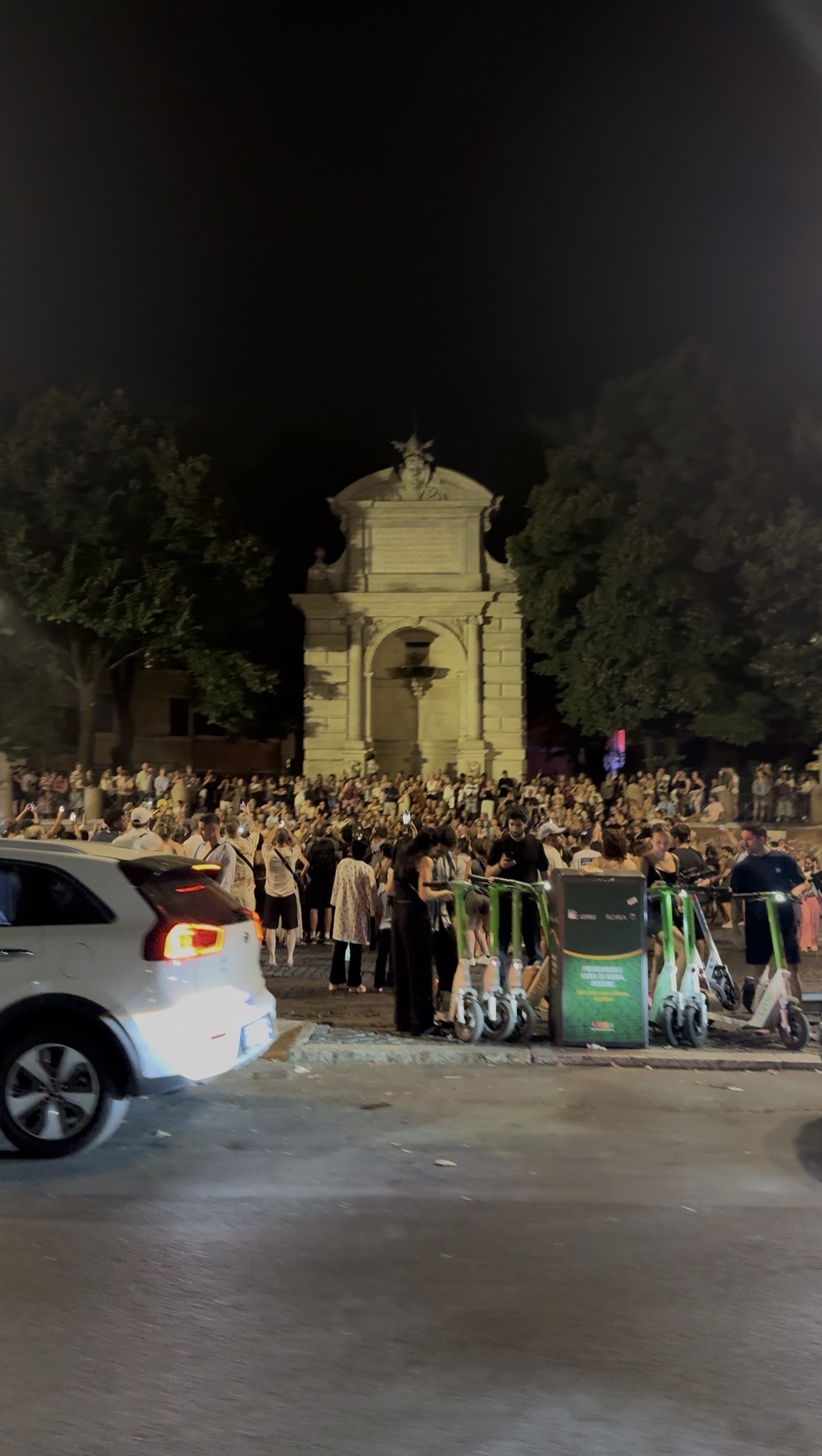
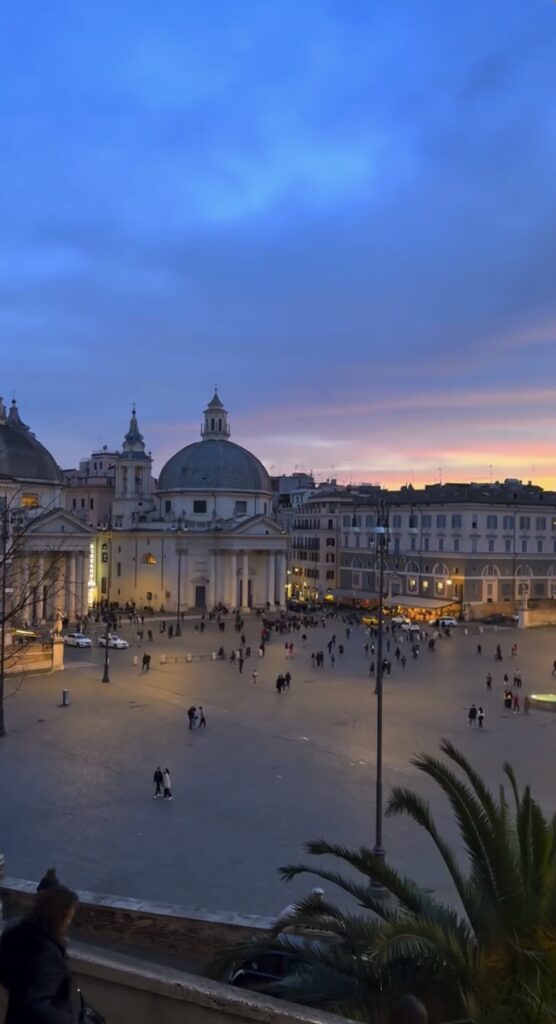
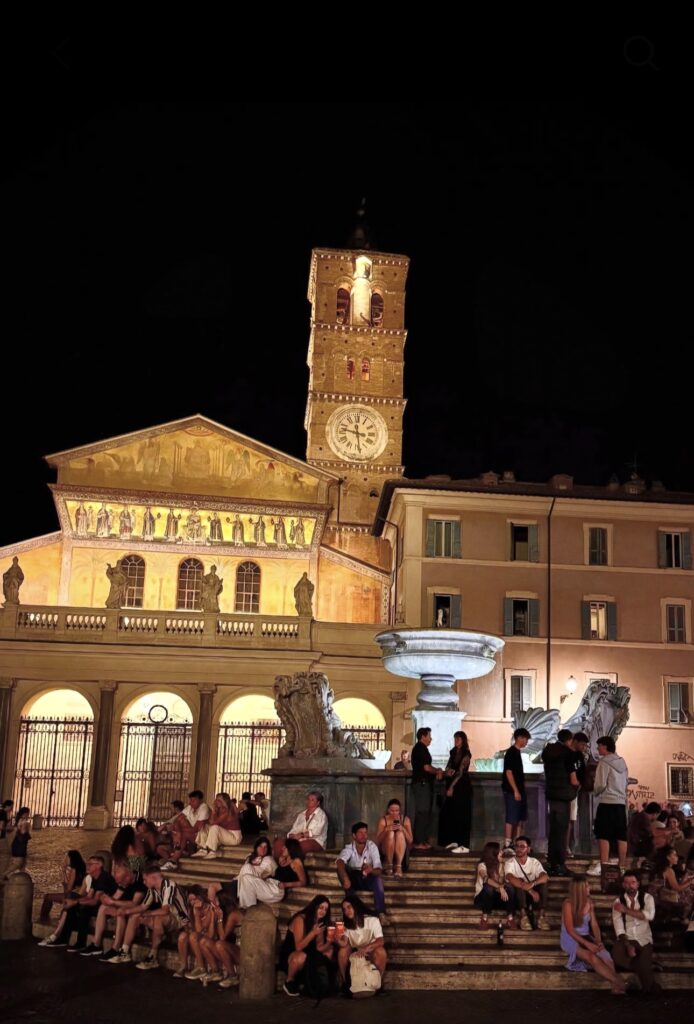
Go to the busy areas — Trastevere, Piazza Trilussa, Piazza del Popolo, Via del Corso — and the first thing you’ll notice is that it feels like midday, because of the sheer number of people around. And you’ll work out for yourself, quickly, that there’s no danger in those parts.
In fact you’ll enjoy it enormously. Trastevere after ten or eleven at night is when the street concerts start, and you’ll live that experience in complete serenity.
The two places we’d avoid after dark
Now the honest part, because a local friend who tells you everything is perfect isn’t being a friend.
There are spots that are best avoided late at night — and the reason is the same one that applies in every big city in the world: after a certain hour the controls thin out and the streets empty.
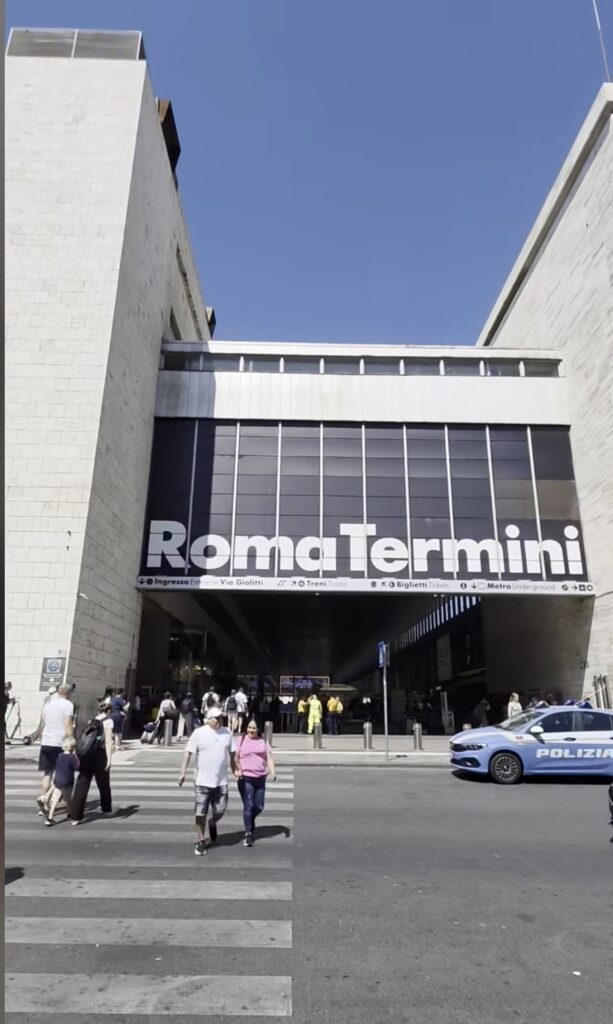
Outside Termini station. And note the precision here: inside the station you’ll have no problem at any hour — there are permanent police and carabinieri posts. The issue is the area outside, at night, when the presence of law enforcement is reduced.
San Lorenzo, late at night. Same principle. Lively and fine earlier; not somewhere we’d wander at three in the morning.
That’s it. Two areas, and only after dark. Everywhere you’re actually likely to be as a visitor stays busy and stays safe.
Public transport: better than its reputation
There are a lot of prejudices about Roman public transport, and on safety they’re simply wrong.
We use it constantly. It works well, it’s well monitored, and it is very safe — here’s how the system actually works if you’re planning your routes. A woman travelling alone, a group of tourists, a man on his own — there’s no danger for anybody. The percentage of thefts is genuinely low.
One small trick, and it’s the only one you need:
Move your backpack to the front. Don’t leave it on your back. Same for handbags — bring them round to your front, especially in a crush.
Even with a low percentage of pickpockets around, that one gesture is the extra bit of care that keeps you out of their reach.
Women travelling alone
This comes up more than any other safety question, so here’s a straight answer.
If we were a woman travelling to Rome, we wouldn’t have any kind of problem. The city has a good safety rating, and the day-to-day reality reflects it.
The additional care we’d suggest is exactly the same as above and no more than that: don’t hang around outside Termini or in San Lorenzo late at night. In the centre, at any hour, you’re fine.
Why Rome takes this seriously
There’s a structural reason behind all of this, and it’s worth knowing.
Rome is safer than its reputation, and there’s a reason for it: this is a metropolis that’s used to tourism. It deals with crime targeting visitors frequently and appropriately — because let’s not forget that tourism is one of the main assets of this entire country.
We won’t tell you it’s one of the safest cities in the world, because on pickpocketing it honestly isn’t. What we’ll tell you is that on the things that frighten people most — violence, being hurt — it’s a genuinely safe city for travellers. And that the one problem it does have is the one you can protect yourself from with a bag worn on the front.
It gets protected. That protection is why you can walk through the centre at midnight without thinking about it.
The only daily danger: crossing the road
We’re only half joking.
Roman traffic is the one thing that genuinely catches visitors out every single day, and it catches them out because they apply the wrong instinct.
Step out with intention. Keep walking at a steady pace. Make eye contact with the driver.
That’s it. That’s the technique, and it works because Roman drivers are reading you constantly — they’re calculating where you’ll be in two seconds and adjusting around you. Give them something to calculate.
What breaks it is hesitation. Stop halfway. Take a step back, then forward again. Freeze because a scooter is coming. Now nobody knows what you’re doing, including you, and that’s when it gets dangerous.
Confident and predictable. It feels wrong for about a day, and then it feels obvious.
But there’s a second thing, and this is the one that actually hurts people: the scooters.
Romans drive in a way that can only be described as mad, and scooters appear from everywhere. Which means that even a pedestrian crossing can be risky if you’re not paying the right kind of attention — because a scooter overtaking out of habit may have reduced visibility, and it will pass the car that has just stopped to let you cross.
That’s the specific danger. Not the car in front of you. The scooter coming past it.
So: stay on the pavements, and look properly for incoming scooters before you step out.
And here’s the honest bit. We’re Roman, we’ve done this our whole lives, and when the green man comes on we still don’t move until we’ve looked. Scooters sometimes follow their own private laws — the ones of being in a hurry, and of not much sense.
One thing to sort before you come: health cover
And here we need to correct something a lot of visitors believe.
Italy’s public healthcare is excellent, and for residents and EU citizens it’s essentially free. But it is not free for you if you’re coming from the US, the UK or anywhere outside the EU.
Non-EU visitors are billed for doctor visits, hospital stays and tests. Emergency stabilisation will always be given — nobody is turned away — but you receive an invoice afterwards.
And here’s the part to get right: you’ll pay upfront and claim it back from your insurer afterwards — if your plan covers you abroad at all. Many US policies don’t. Medicare doesn’t, full stop. Check before you fly, and keep every receipt (fattura), because that’s what you’ll be submitting.
Real numbers, so you can judge: a non-urgent visit carries a ticket fee of around €50, plus charges for any tests. A few hours in an emergency department with diagnostics typically runs €150–€400. A night held under observation can be around €400.
Now put that in perspective, because this is the part that should reassure you: those are a fraction of what the same treatment costs in an American hospital — and broadly in line with what everything else costs here, where a single night can run into five figures.
So: get travel medical insurance. It’s inexpensive, it’s the standard advice for anywhere outside your own healthcare system, and it turns the only real financial risk of your trip into a non-issue.
(If you’re applying for a Schengen visa, insurance with €30,000 of cover is compulsory anyway.)
If it does happen: what to do, in order
Nobody writes this part, and it matters. If you’re robbed, the order of what you do determines how much it costs you.
First — and before anything else — block your cards.
Not after the police. Before. Because the cash isn’t the main prize: emptying your cards is. And the method is faster than you’d think. Using a friendly shop, they run repeated contactless transactions — the kind that don’t require a PIN — until they’ve taken hundreds or even thousands of euros.
Why speed decides everything. Under EU rules, once you’ve notified your bank you’re not liable for anything that happens afterwards. Before you notify, your liability is capped but not zero — and contactless payments sit under a specific carve-out with lower protection, precisely because no PIN was used. And crucially: the right to a refund depends on reporting without undue delay.
So blocking the cards isn’t just practical. It’s what converts your loss into the bank’s problem instead of yours.
Second: go to the nearest police or carabinieri station and file a report — the denuncia. You’ll need it for your insurance claim, and for replacing documents.
And this is exactly why Nico tells you to leave your documents at the hotel — we covered his reasoning here. The most infuriating part of being pickpocketed isn’t the money. It’s losing your passport, and the time an embassy takes to issue a replacement, which can be long enough to put the rest of your trip at risk.
Cash you can replace. A passport on a Friday afternoon in August, less so.
What we’d say to you, honestly
If you’ve arrived at this article after reading something frightening online, here’s what we’d tell a friend.
Come. Walk everywhere. Sit in the piazzas late. Go to Trastevere at eleven and listen to whoever is playing in the street.
Keep your bag in front of you in a crowd, keep your cash in your front pocket, skip the area outside Termini at two in the morning, cross the road like you mean it, and bring travel insurance.
And one number to know: 112. It’s the European emergency line — police, ambulance, fire, all of it — and English-speaking operators are available. You almost certainly won’t need it. Save it anyway.
That’s the entire list.
The short version
- Yes, Rome is safe — safer than its reputation, with a constant police and army presence in the centre
- Rome doesn’t have street robbery. It has very skilled pickpockets in crowded, touristy places
- In the centre there’s no unsafe hour. Trastevere at 11pm feels like midday
- Avoid after dark: outside Termini station (inside is fine, 24h police posts) and San Lorenzo
- Public transport is safe. Move your backpack and bag to the front in crowds
- Women travelling alone: no particular problem, same advice as everyone else
- Crossing the road: walk with intention, steady pace, eye contact. Hesitation is what’s dangerous
- Watch for scooters, not cars — they overtake the vehicle that stopped for you
- If you’re robbed: block your cards first, then file a police report. Speed protects your refund rights
- Emergency number: 112, English-speaking operators available
- Healthcare is not free for non-EU visitors. You pay upfront and claim back later — check your plan covers abroad. Medicare doesn’t. Costs are far lower than in the US
- You’ll arrive more worried than you need to be
Common questions
Is Rome safe at night?
In the centre, yes — there is no unsafe hour. Trastevere at eleven at night feels like midday because everyone is out. The two exceptions are the area outside Termini station and San Lorenzo, both late at night.
Is Rome safe for solo female travellers?
Yes. The advice is the same as for everyone else: bag worn in front in crowds, cash in your front pocket, and skip those two areas after dark. In the centre, at any hour, you are fine.
Do you need travel insurance for Rome?
Yes, if you are coming from outside the EU. Italian healthcare is excellent but not free for you — you pay upfront and claim it back afterwards, and Medicare does not cover you abroad at all.
More real Rome, one honest tip at a time — callmeitaly.com