How to Avoid Taxi Scams in Rome: A Local Driver’s Honest Guide (2026)
The fixed fares, the dirty tricks, and how to spot a real Roman taxi — straight from someone who drives them for a living.
Landing in Rome should feel like the start of something wonderful. Too often, it starts with a rip-off at the taxi rank.
It doesn’t have to. Most Roman taxi drivers are honest professionals. But a small dishonest minority has given the whole category a bad name — and tourists, tired after a long flight and unsure of the rules, are the easiest targets.
So we did something simple: we asked a Roman taxi driver to tell us, plainly, how his own dishonest colleagues cheat visitors — and exactly how to protect yourself. What follows is the honest version. The one the guidebooks don’t quite give you.
First, the good news: Rome has fixed airport fares
Here’s the single most important thing to know, and the one that saves the most people from being overcharged: the fare from the airport to the city centre is fixed by law. It is not negotiable, and it does not run on the meter.
The official rates (confirmed by Aeroporti di Roma for 2026):
- Fiumicino (FCO) → central Rome, within the Aurelian Walls: €55, flat.
- Ciampino (CIA) → central Rome, within the Aurelian Walls: €40, flat.
- Airport to airport (Fiumicino ↔ Ciampino): €55.
These fixed fares are all-inclusive. That means for a normal trip they cover luggage, passengers, and any time-of-day surcharge. One dishonest move to watch for: a driver “adding” extras onto the flat fare. On the fixed airport rate, the first bag is always free and there are no legitimate add-ons for a standard ride. If the number climbs above the flat fare, something is wrong.
One crucial detail most tourists miss — and our driver flagged it immediately: check the licence plate and the door. A genuine Rome city taxi carries the wording “Roma Capitale.” Some taxis are registered to the Comune di Fiumicino instead — these can legally run the meter and end up far more expensive than the €55 flat rate. If the licence says “Roma,” you’re paying the fixed fare. If it says “Fiumicino,” walk to the next car in the rank.
The “Aurelian Walls” simply mean central Rome — the historic core, including the Vatican, Trastevere, Testaccio, the Colosseum area, and most neighborhoods where you’re likely staying. If your hotel is central, the flat fare almost certainly applies.
How the meter actually works inside the city
For trips inside Rome (not the airport), it’s the opposite rule: you go strictly by the meter — always. No agreed “flat price” for a ride across town. If a driver offers you a fixed price for a trip within the city, that’s a red flag.
The meter starts from a base fare depending on the time:
- Daytime (weekdays, roughly 6am–10pm): base around €3.
- Sundays and public holidays: a higher base (around €5).
- Night (10pm–6am): the highest base (around €7).
From there, the fare climbs by distance, and the per-kilometre rate steps up through three tariff bands the further and longer you travel. You don’t need to memorize the exact cents — you need to know that the meter is running and visible, and that the price should track your actual route.
Which leads to the simplest anti-scam tool you already own:
Open your own map app and watch the route. Our driver put it plainly: your navigator and his won’t match to the metre, but they’ll be close. “If the customer’s app says 5 kilometres, the driver can do 6 at most — not 9.” If your 5-km trip suddenly becomes a 9-km “scenic tour,” you’re being taken for a ride in the worst sense.
A taxi isn’t always the answer, of course — here’s when the bus or metro wins instead, and how the ticket system works.
The dirty tricks — and how to shut them down
This is the part no official brochure will hand you. Here are the moves a dishonest driver might try, and the simple defense for each.
1. The cash-swap sleight of hand
The nastiest one, and it targets travelers unfamiliar with euro notes. The driver offers to “help” with your wallet or your change, and with fast hands swaps your €50 notes for €10 ones — then insists you gave him less than you did. Our driver was blunt about it: they’re very smooth talkers and even faster with their hands.
Defense: Never let anyone put their hands in your wallet. Count your own money, hand over the exact amount yourself, and state the note clearly as you give it (“this is fifty”). Better still — see the next section — pay by card.
This one isn’t unique to taxis. We’ve collected every scam a Roman taxi driver sees on the streets, from the three-card game to the petition clipboards.
2. The “agreed price” inside the city
A driver quotes you a set price for a cross-town ride instead of using the meter. Inside the Comune di Roma, that’s not how it works.
Defense: Insist on the meter. If they won’t turn it on, get out and take the next taxi.
3. “Extras” piled onto the fixed airport fare
The €55 / €40 flat fares already include luggage and passengers for a normal trip. Inventing surcharges on top is a classic squeeze.
Defense: Know the flat fare before you get in. State your destination and “fixed fare, please.” The number shouldn’t move.
4. The fake taxi / the “abusivo”
Unlicensed drivers who approach you inside the terminal, offering a ride to the city. They quote inflated prices and answer to no regulator. Our driver’s tip is the cleanest tell of all:
The illegal ones are never in the official queue. Real taxis line up one behind the other at the rank outside arrivals, because to enter the airport taxi system they must take a ticket — and only authorized taxis can. So: never accept a ride from someone walking around the arrivals hall or approaching the waiting line. Walk past them, out to the official rank, and join the queue.
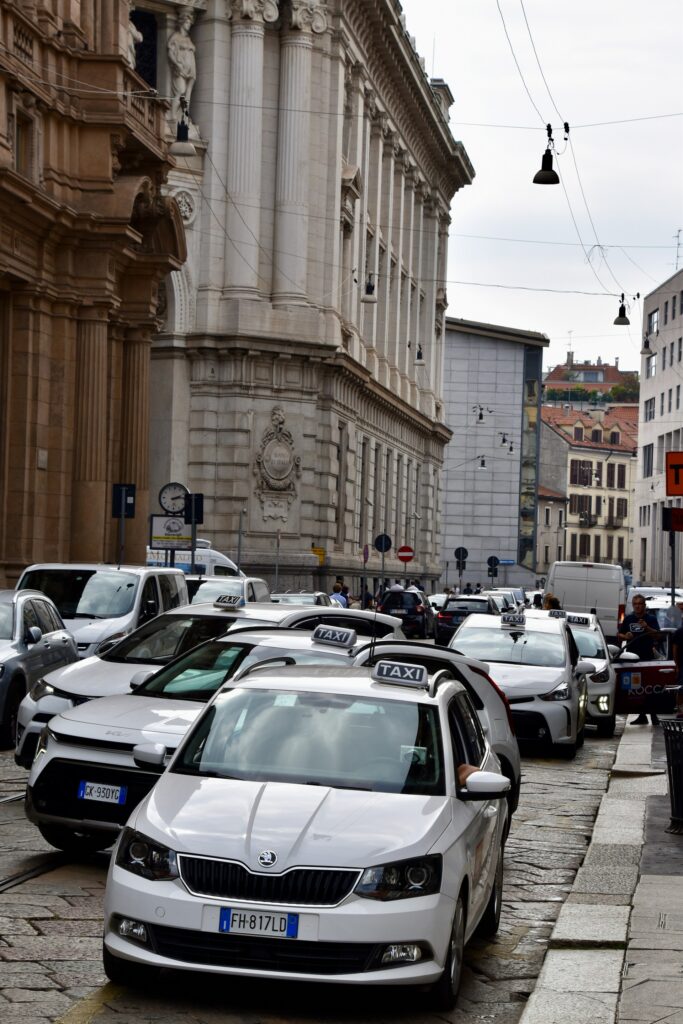
How to spot a genuine Roman taxi in five seconds
Our driver’s checklist, boiled down. A legitimate Rome taxi has:
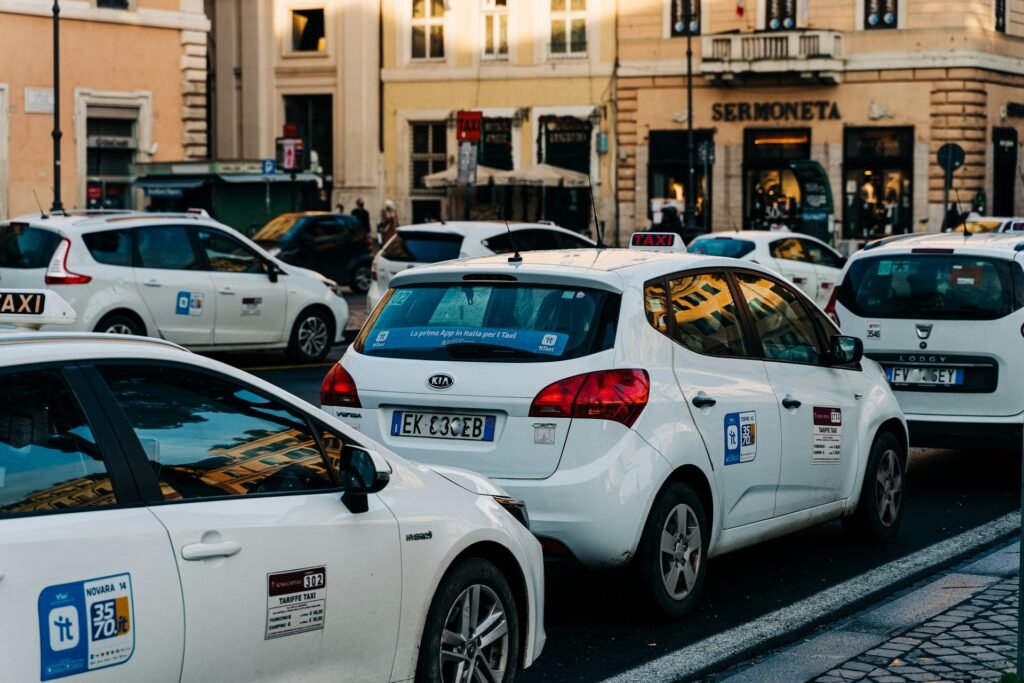
- White paintwork — always. Any other color is not an official Rome taxi.
- A “TAXI” sign on the roof.
- The licence number displayed on the doors, on the rear, and set into the bodywork — plus the licence visible inside.
- The fare table displayed on the front doors — large, official, listing the fixed routes (including long-distance runs like Civitavecchia).
- A meter, mounted in view. For city trips it must be on. For the airport flat fare it doesn’t apply — but the fixed rate does.
If those things aren’t there, it isn’t a real one.
The apps that actually work in Rome
Skip the street uncertainty and book through an app. The ones our driver named as legitimate for Rome:
- FREE NOW — widely used, connects you to licensed white taxis.
- itTaxi and inTaxi — official Italian taxi apps.
- Uber — available in Rome, but it works differently than at home: it pairs with licensed taxi/professional drivers rather than private cars, so expect taxi-style service.
You can also call one of Rome’s big radio-taxi lines directly (dial the Rome 06 prefix): 063570, 066645, 065551. Note that booking a taxi to come to you adds a small call-out charge — that one is legitimate.
Taxi vs. train: which is actually cheaper?
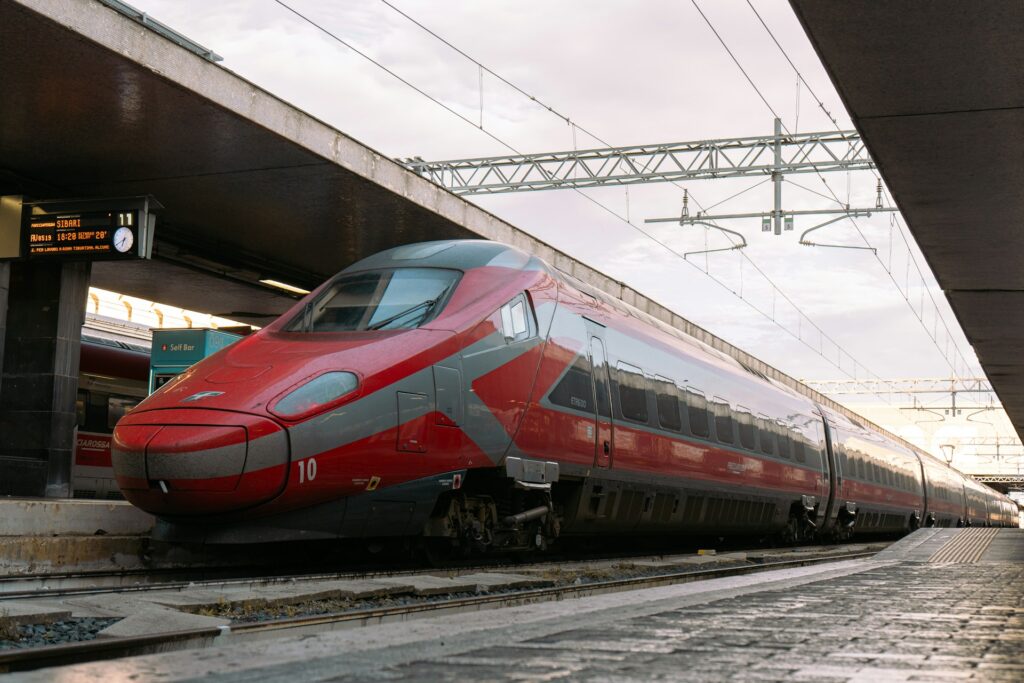
The Leonardo Express runs non-stop from Fiumicino to Termini in about 32 minutes for around €14 per person. Convenient — but do the math for your group.
- Four people by train: roughly €56 in tickets — and you still have to get from Termini to your hotel, likely another taxi with your bags in the heat. Call it €56 + ~€20 = ~€76.
- Four people by taxi: the €55 flat fare, door to door, bags included.
So for a group of three or four with luggage, the fixed-fare taxi often wins on both price and comfort — you arrive at your door, not at a station. The train makes most sense if you’re solo, traveling light, and actually staying near Termini. As our driver put it: the Leonardo only really pays off if Termini is your destination — otherwise four tickets cost more than the one taxi that drops you at the door.
Transport is one line in a bigger budget — here’s what a full day in Rome actually costs, from breakfast to dinner.
Going outside the city? Now you can negotiate
There’s one case where agreeing a price is normal and correct: destinations outside the Comune di Roma (or outside the region entirely) — day trips, ports, distant towns. Here the meter rules don’t apply and you settle a price up front.
A fair benchmark from our driver: don’t pay more than about €3 per kilometre, with roughly €2.50–€3/km being a good high-season rate. Why not less? Because the driver returns empty — that long drive back with no fare is baked into the price. In low season, a friendly driver might do €2–2.20/km. Knowing this range means you can recognize a fair quote instead of guessing.
The bottom line
Rome’s taxis are, in the vast majority, honest and well-run — the city fixed the airport fares precisely to stamp out the old rip-offs. The scams that remain are few, predictable, and almost entirely avoidable once you know the rules:
- Airport to centre is fixed — €55 Fiumicino, €40 Ciampino, bags included.
- Look for white cars, the “Roma Capitale” plate, the roof sign, the meter.
- Inside the city, meter only. Outside the city, agree a fair €2.50–3/km.
- Never let hands into your wallet; never follow someone from inside the terminal — join the official rank.
- When in doubt, book through an app.
Do that, and the only thing you’ll remember about your ride into Rome is the moment the city first came into view.

Common questions
How much is a taxi from Fiumicino to Rome?
€55 flat to anywhere inside the Aurelian Walls, luggage and passengers included. From Ciampino it’s €40. The fare is fixed by law and shouldn’t move — if it does, something is wrong.
How do you know if a Rome taxi is official?
White paintwork, a TAXI sign on the roof, a licence number on the doors and rear, the fare table displayed on the front doors, and a visible meter. At the airport, check the licence says “Roma Capitale” and not another comune.
Should you tip a taxi driver in Rome?
It’s welcome but never expected. There’s no percentage to calculate — round up if the ride was good and you feel like it. Nobody will be put out if you simply pay the fare.
More real Rome, one honest tip at a time — callmeitaly.com