How to Get Around Rome in 2026 (and Avoid the €100 Fine Tourists Always Get)
Metro, buses, tickets, the fines nobody warns you about, and when a taxi is actually the smart choice — straight from someone who drives the city for a living.

Rome is one of the most beautiful cities on earth. It is also, let’s be honest, one of the most confusing to move around. Narrow streets, endless one-ways, a metro that somehow never seems to go exactly where you’re standing.
So we went back to Nico, our Roman taxi driver, and asked him the question every visitor eventually asks: how do I actually get around this city? Here’s his honest, no-nonsense answer — the public transport, the tickets, the traps, and the moment when, yes, you should just take a taxi.
The metro: useful, but smaller than you think
Rome has three metro lines: A, B, and C. As Nico puts it, the two that matter most for visitors are A and B — they’re the best-connected to the center and cross at Termini station.
Here’s the honest limitation, though: Rome’s metro is smaller than you’d expect for a capital city. It often leaves you a 5–15 minute walk from where you actually want to be. That’s not a flaw in your planning — it’s just Rome. The ancient center is so protected by archaeology that they can’t dig metro lines under most of it.
Which is exactly why locals lean so heavily on the buses.
The local secret: learn the buses, not just the metro
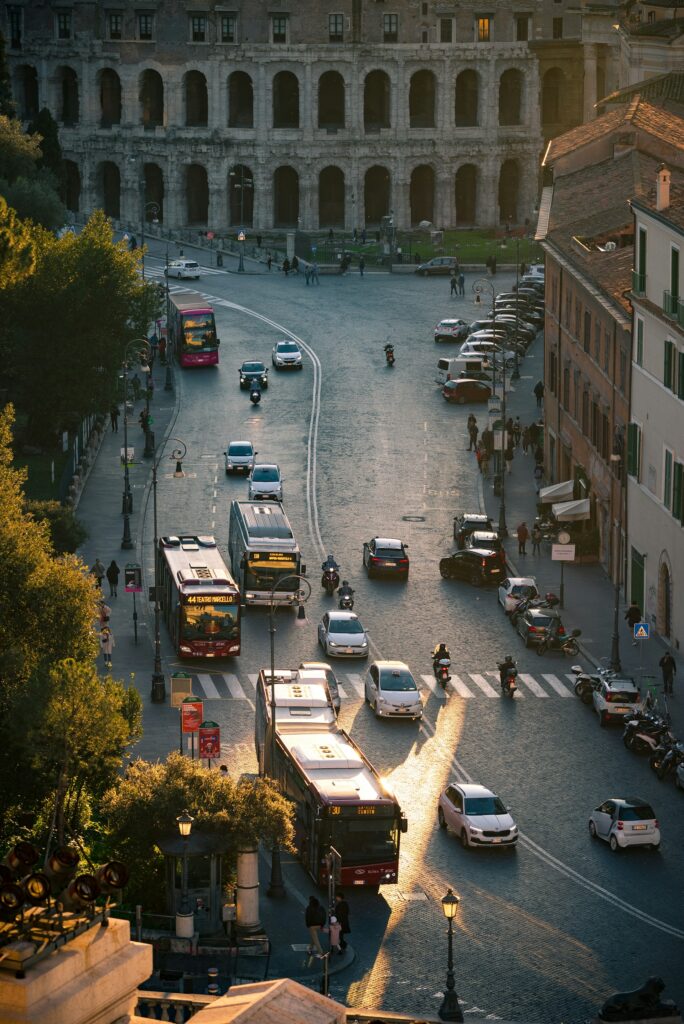
This is the tip that separates tourists from people who move like Romans. The bus and tram network reaches all the places the metro never will — most of the historic center included.
If you learn just three bus routes — the 8, the 64, and the 40 — you’ll navigate Rome like a local within a couple of days. (A word of warning on the 64: it’s the workhorse line between Termini and the Vatican, which also makes it a favorite hunting ground for pickpockets. More on that below.)
Trams, too, are genuinely handy on certain routes and often quicker than fighting traffic.
Tickets: the €1.50 rule — and the €100 mistake
Let’s make this simple, because this is where tourists lose money.
One ticket — the BIT — costs €1.50 and lasts 100 minutes. In that window you can take unlimited buses and trams, switching lines as much as you like. On the metro, though, it covers one single ride — once you exit through the turnstiles, it’s done.
Now, the part that catches people out and it’s a big one:
You MUST validate your paper ticket. Stamp it in the machine the moment you board the bus or enter the metro. If you don’t — even if you paid for a perfectly valid ticket — inspectors can fine you €100 or more on the spot. Every year thousands of tourists get hit with this simply because nobody told them. Now you know.
The 2026 upgrade that makes life easier: most of Rome’s metro turnstiles and validators now take Tap & Go contactless. Just tap your Visa, Mastercard, Apple Pay or Google Pay on the red reader — €1.50 is charged automatically, and it validates itself, so there’s no ticket to stamp and no fine to risk. Even better, there’s a daily cap of €8.50: once your taps hit that in a single day, the rest of your rides are free until midnight. For most visitors, contactless is now the smartest, safest way to ride.
If you’d rather buy paper tickets, grab them at any tabacchi (the shops with a green “T” sign), newsstands, or station machines — you can’t buy them onboard.
Transport is one line in a much bigger picture — here’s what a full day in Rome actually costs, hour by hour.
When the bus wins, and when a taxi wins
Nico is a taxi driver, but he’s refreshingly honest here — as he says, “I don’t want to carry water to my own mill,” the Italian way of saying he won’t just push you toward taxis.
By day, for one or two people, public transport wins. It’s frequent, cheap, and efficient — especially around the center. Take the bus, take the metro, save your money.
Here’s his rule of thumb for when a taxi makes more sense:
- Three or more people. Split between you, a typical cross-town ride works out to just a few euros each — a city-center taxi trip runs roughly €25–30 by day, so three people pay around €7–10 each, door to door, no walking, no figuring out routes.
- At night. After the metro closes (around 11:30pm), Nico’s advice is clear: take a taxi. It’s simply safer, and moving between zones late at night on patchy night buses is a hassle. A center-to-center ride at night tops out around €20 — split three ways, that’s peace of mind for the price of a couple of coffees.
- From the airport, with luggage. For a group of four, the taxi almost always beats the train. Remember the fixed fare: €55 flat from Fiumicino to central Rome, door to door, bags included. The Leonardo Express is €14 per person and only drops you at Termini — from there you’ll still need another taxi to your hotel, with your bags, after a long-haul flight. Do the math and the fixed-fare taxi usually wins on both money and sanity.
Before you get in one, read how to tell an official taxi from the rest — it’s the single most common way visitors get overcharged here.
Don’t rent a car. Really.
If there’s one thing Nico wants visitors to hear, it’s this: unless you’re a genuinely confident, alert driver, do not drive in Rome.
And it’s not because he wants you in a taxi — he’d happily send you to the bus. It’s because Rome is genuinely one of the hardest cities in the world to drive. Narrow streets, endless one-ways, non-stop roadworks, roads that close overnight. As he puts it, “even the sat-nav gets you lost.” It takes, in his words, “il pelo sullo stomaco” — a thick skin — and a lot of patience.
And then there’s the ZTL — the trap that costs tourists a fortune. ZTL stands for Zona a Traffico Limitato, a Limited Traffic Zone covering much of the historic center. Only authorized vehicles and residents can enter. Drive into one without permission — as countless tourists do, following a sat-nav straight past the cameras — and the fines land in your mailbox weeks later, one for each time you crossed. People rack up hundreds of euros without ever realizing it in the moment.
There’s one more reason to leave the car alone, and it’s less obvious: the wing mirror scam. Someone throws themselves at your car and claims you hit them — and without the language, proving otherwise is very difficult.
The verdict: skip the rental car for the city entirely. Move around on public transport, taxis, or your own two feet.
A driver’s trick to never be taken the long way
Here’s a clever one from Nico, useful even inside a taxi. Download Waze (or any map app) and set your destination yourself before you set off. With the route on your own screen, you can quietly see whether the driver is taking the sensible path — or “giving you the scenic tour” around your destination to pad the meter. You don’t need to say anything; just having it open keeps everyone honest.
Stay safe: pickpockets, and the passport rule
Rome isn’t dangerous — Nico is clear on that. But it does have a serious, well-organized pickpocket problem, especially on the metro and on busy tourist bus lines like the 64. So a few habits from a local who watches this every day:
- Pay by card wherever you can. You can pay with a card almost everywhere in Rome, so you rarely need much cash on you.
- Never carry your passport around the city. This is Nico’s strongest piece of advice. Lock it in the hotel or B&B safe and carry, at most, a driver’s licence or ID card. If your wallet gets lifted with your passport in it, your holiday is genuinely ruined — replacing it abroad is a nightmare. Leave it locked away and your trip home is safe no matter what.
- Keep a card and about €100 in a front pocket — within reach, not in a back pocket — and check now and then that everything’s still there.
None of this means Rome is unsafe — quite the opposite. We’ve written the honest answer to that question, including what to do first if it does happen to you.
The bottom line
Getting around Rome isn’t hard once you stop fighting it. Here’s Nico’s honest summary:
- By day, one or two people: buses, trams, metro. Cheap and efficient.
- Learn the 8, 64 and 40 and you’ll move like a local.
- Tap & Go contactless is the easiest way to pay — no stamping, no €100 fine.
- Three+ people, at night, or from the airport with bags: take a taxi. Book through FREE NOW or itTaxi, and remember taxis don’t come to you — you go to the official rank.
- Don’t rent a car. Respect the ZTL. Keep your passport in the safe.
Do that, and Rome stops feeling like a maze and starts feeling like the greatest open-air museum on earth — which is exactly what it is.
Common questions
How much is a metro ticket in Rome?
A single BIT ticket costs €1.50 and lasts 100 minutes across buses and trams, or one metro journey. If you tap contactless instead, there’s a daily cap of €8.50 — after that, the rest of the day is free.
Do you have to validate tickets in Rome?
Yes — paper tickets must be stamped the moment you board. Inspectors check, and the fine is €100 or more even if you paid properly. Contactless validates itself, which is why we’d use it.
Is it worth renting a car in Rome?
No. Between the one-ways, the roadworks and the ZTL cameras that post fines to you weeks later, driving here costs money and patience for no benefit. Use it only to leave the city.
More real Rome, one honest tip at a time — callmeitaly.com